Perspective
The Streaming State Tax: Why Log-First Architecture Forces Database Sprawl
Log-first streaming brokers store opaque bytes, forcing downstream consumers to rebuild redundant materialized state. Table-first engines like Apache Fluss collapse state into storage to eliminate operational debt.
September 1, 2026 · Perspective · Leon Liang
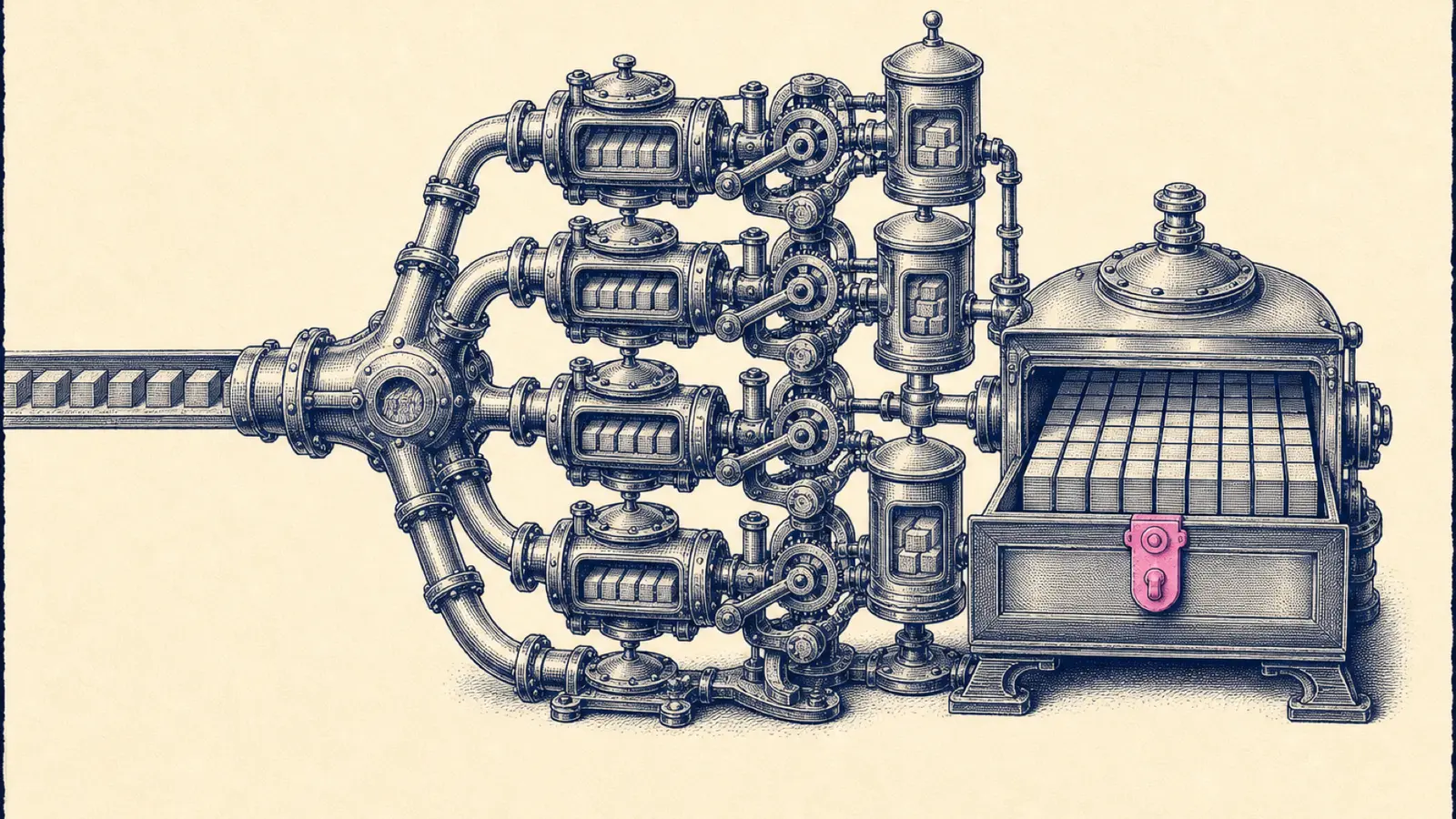
Many engineering teams assume that operating separate state backends across streaming consumers is an unavoidable requirement of real-time systems. This is a misconception. Redundant downstream state is the direct structural outcome of traditional log-first storage systems.
The Opaque Byte Model and Downstream State Duplication
In traditional log-first platforms like Apache Kafka, brokers maintain an append-only sequence of opaque byte records [agy:1]. Because the broker does not parse or structure record payloads, materialized state, such as current row values and Change Data Capture (CDC) states, cannot live in the log [agy:1]. Downstream consumers must independently reconstruct and maintain that state [agy:1].
When a Flink job, a ksqlDB instance, and a microservice consume the same stream, each application independently synchronizes its own internal state store [agy:1]. Kafka also treats record payloads opaquely across the wire, requiring consumers to pull full serialized records over the network before applying filters [agy:2].
The Infrastructure Cost of Multi-Database Sprawl
This log-first model imposes a state duplication tax on data engineering teams. Organizations routinely manage identical reference datasets across Flink RocksDB state, ksqlDB instances, Redis caches, and Cassandra clusters [agy:1].
For startups and scale-ups, this multi-database sprawl creates heavy operational maintenance and multiplies cloud infrastructure bills [agy:5]. Every additional consumer service introduces another redundant copy of identical materialized entity state [agy:1, agy:5].
Aeolus Data Solutions view. The rise of table-first streaming is not just a query latency tweak. It represents an architectural consolidation that moves state materialization directly into the storage layer. By shifting state management out of consumer memory, data teams can remove redundant caching layers and reduce operational overhead.
Folding Materialized State into the Storage Engine
Apache Fluss introduces a table-first architecture designed to eliminate redundant consumer state [agy:1]. In Apache Fluss, Primary Key Tables natively combine an append-only changelog with an indexed key-value state store backed internally by RocksDB [agy:1].
This table-first design allows multiple downstream streaming pipelines and analytical engines to share a single authoritative materialized state [agy:1]. Shared reference tables, CDC entities, and dimension lookup joins no longer require each consumer to maintain its own duplicate state store [agy:1]. Local state remains preferable only for application-specific processing logic unique to an individual streaming pipeline [agy:1].
Columnar Hot Streaming and Broker-Level Pruning
Beyond embedded key-value storage, table-first engines like Apache Fluss structure streaming logs using Apache Arrow [agy:2]. Maintaining streaming data in columnar format in memory and on the wire enables projection pushdown directly at the storage broker [agy:2].
Brokers can prune columns and transmit only requested fields across the network, avoiding the bandwidth cost of full-record transmission [agy:2]. Columnar layouts introduce small batching overheads for fine-grained, row-by-row event streaming compared to raw byte logs, but provide significant bandwidth and computation savings for wide-schema datasets and analytical stream processing [agy:2]. In addition, columnar memory structures facilitate vectorized aggregation across in-memory batches, bridging stream ingestion and real-time analytical scanning [agy:2].
Resolving Lakehouse Compaction with Union Reads
Pushing lakehouse formats such as Apache Iceberg or Apache Paimon to sub-second streaming commits causes severe small-file accumulation and high copy-on-write or merge-on-read compaction costs [agy:3].
Modern streaming table architectures solve this through union reads [agy:3]. Query engines fetch stable historical snapshots from object storage (Paimon or Iceberg) while simultaneously reading the uncommitted real-time tail from hot streaming storage like Fluss [agy:3]. Apache Paimon uses an LSM-tree design with changelog-producer engines suited for high-frequency CDC merges, while Apache Iceberg provides broad cross-engine analytical interoperability [agy:3]. While Kafka Tiered Storage retains data strictly in Kafka log format accessible only through Kafka consumer APIs, Fluss tiering converts data representation into open lakehouse formats readable by external query engines [agy:3].
Architectural Coexistence: Kafka and Table-First Streaming
Confluent Tableflow narrows the gap for log-first architectures by automatically materializing Kafka topics into Apache Iceberg tables without external ETL pipelines, supporting hybrid Flink queries across Iceberg snapshots and the live Kafka tail [agy:4]. However, Tableflow upsert mode remains bound to Kafka partition semantics, where repartitioning topic events can split key history across partitions [agy:4]. In contrast, Apache Fluss rejected Kafka wire protocol compatibility on its roadmap to avoid log-only constraints, establishing itself as a dedicated table-first engine with native clients in Java, Rust, Python, and C++ [agy:4].
Apache Fluss graduated as an Apache Top-Level Project in August 2026 with a v0.9.1 stable release and an early Rust and Python client ecosystem [agy:5]. Apache Fluss is not a drop-in replacement for company-wide Apache Kafka event fabrics [agy:5].
Apache Kafka remains the standard for broad enterprise integration backbones, transactional event choreographies, and architectures requiring mature tooling like Kafka Connect and Schema Registry [agy:5]. Apache Fluss serves as an optimized streaming storage engine for CDC entities, reference data joins, and real-time analytical workloads [agy:5]. By deploying table-first storage specifically where state materialization creates database sprawl, teams can consolidate caching layers while maintaining their primary messaging backbone [agy:5].
If your team is evaluating streaming state management or seeking to eliminate redundant storage layers across your pipelines, Aeolus Data Solutions invites you to reach out and explore your data platform architecture.
Want a second opinion on your data stack?
Every Aeolus engagement starts with a fixed-fee data & AI-readiness audit — a short, low-risk first step before any larger build.
Book a data & AI-readiness audit