Perspective
The Cluster Tax: Why Right-Sized Analytics Beats Distributed Sprawl
Distributed query clusters add operational drag to workloads that fit in memory. Embedded engines restore fast local iteration and reliable CI/CD testing.
August 31, 2026 · Perspective · Leon Liang
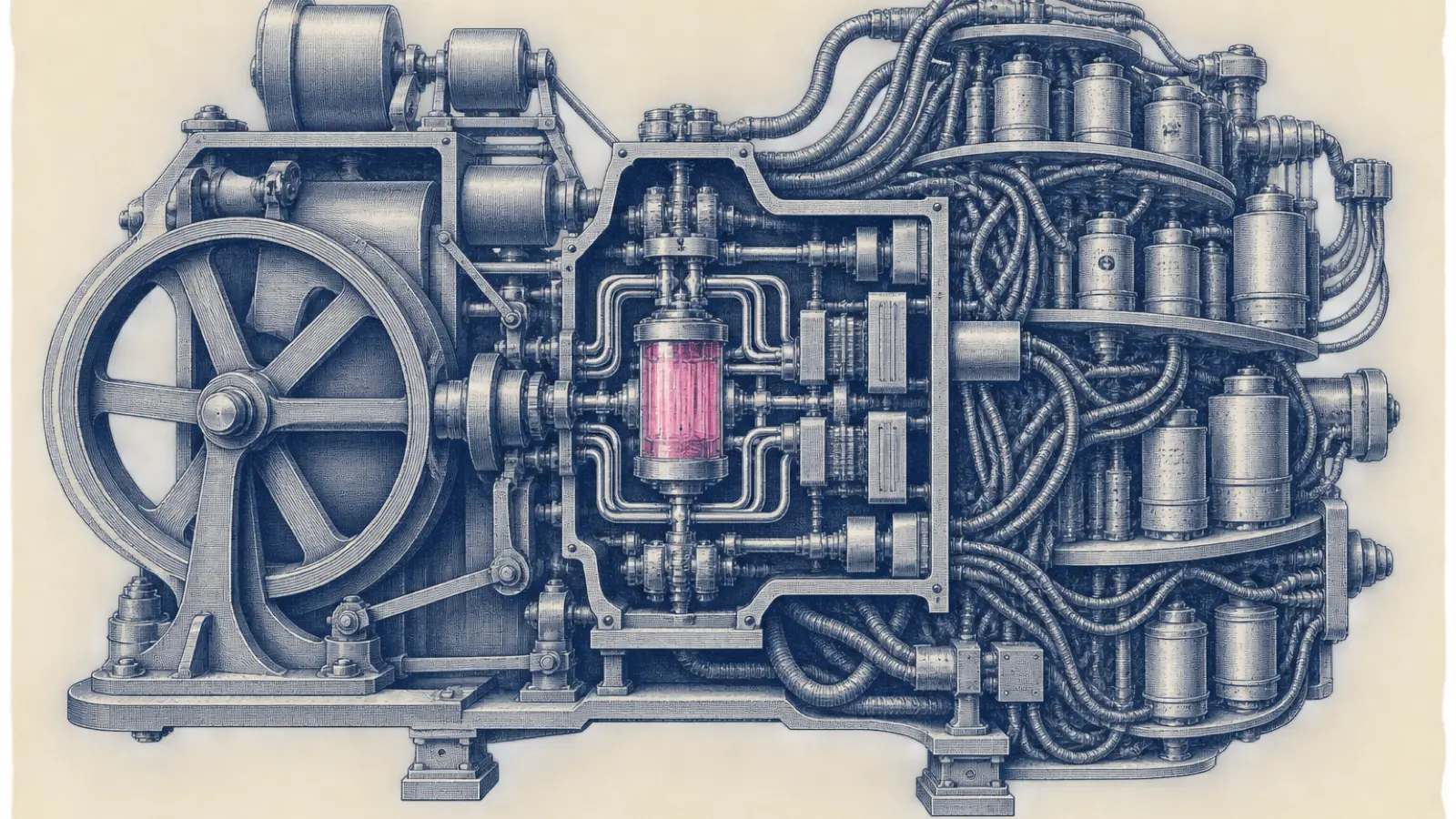
A common misconception across data engineering is that scaling analytical pipelines requires multi-node distributed compute clusters from the beginning. Teams frequently assume that managing Spark clusters or dedicated warehouse nodes is a prerequisite for production-grade data processing. In reality, distributed query clusters impose a heavy operational cluster tax (cold starts, node skew, network shuffle overhead, and unreproducible local environments) on workloads that fit comfortably within modern single-node server memory.
The Operational Drag of the Cluster Tax
Distributed processing was designed to solve storage and compute limitations that most scale-up workloads never encounter. When teams introduce distributed compute clusters prematurely, data engineers spend significant time diagnosing cluster coordination failures, tuning memory partitions, and waiting for slow cluster spin-ups instead of building product features.
This operational friction directly impacts data reliability. Industry benchmarks from the Monte Carlo State of Data Quality report show that data engineering teams handle an average of 60 or more data incidents per month. Resolving these incidents takes an average mean time to resolution (MTTR) of 15 hours, with downstream pipeline downtime affecting up to approximately 31% of revenue. When data pipelines cannot be executed locally or tested deterministically, debugging these failures requires inspecting remote cluster logs and waiting on remote infrastructure.
In-Process Engines and Local Development Parity
Following DuckDB’s 1.0 General Availability release and format stabilization, data engineering teams are shifting away from distributed cluster sprawl toward right-sized analytics. Embedded in-process analytical engines and serverless hybrid execution models, such as MotherDuck dual execution and DuckLake, execute sub-second analytical queries directly within applications or CI/CD pipelines.
By running analytical workloads in-process, teams eliminate warehouse compute overhead and multi-node cluster startup latency. Data transformations run identically on an engineer’s laptop, in pull request validation suites, and in production pipelines. While petabyte-scale distributed streaming joins across thousands of nodes still warrant distributed engines, the vast majority of scale-up workloads operate well within modern single-node and serverless boundaries.
Decoupling Storage and Compute with Open Catalogs
Adopting embedded and single-node query engines does not require sacrificing centralized governance or standardized storage. The lakehouse ecosystem has converged around open table formats and standardized REST catalogs that decouple data storage from compute engines.
Snowflake open-sourced Apache Polaris, which graduated to an Apache Top-Level Project in early 2026, and Databricks open-sourced Unity Catalog under the LF AI & Data Foundation. Organizations can maintain a single vendor-neutral storage layer on Apache Iceberg or Delta Lake that serves multiple compute engines simultaneously. A single dataset can be queried by DuckDB for lightweight local workflows, Snowflake or Trino for interactive querying, or Apache Spark and Apache Flink when specialized processing is required.
Catching Schema Failures Early with Executable Contracts
Eliminating cluster complexity enables teams to apply standard software engineering practices to data pipelines. Using the Open Data Contract Standard (ODCS), governed under the Linux Foundation’s Bitol project, data teams define machine-executable data contracts as declarative YAML specifications.
These specifications codify schema definitions, semantic quality assertions, and SLA constraints directly within CI/CD workflows. Instead of discovering breaking upstream schema modifications after production pipeline failures, pull request checks catch breaking changes before corrupted data reaches downstream analytics or AI systems.
Multimodal AI Workloads Without Cluster Sprawl
As data teams prepare infrastructure for machine learning and agentic workflows, unstructured and vector data often introduce additional cluster sprawl. Standard columnar formats like Parquet were designed for batch analytical processing rather than high-performance random access or multimodal data.
The open-source Lance columnar format, incorporating the Lance 2.2 format specification, and the embedded LanceDB vector lakehouse combine raw binary media, dense embeddings, and relational metadata into an ACID-compliant storage layer. This architecture provides high-speed random access and native hybrid search (combining BM25, vector search, and SQL) for agentic frameworks such as CrewAI without requiring separate vector database clusters. For organizations with hybrid requirements, high-throughput batch distributed transformations can still run on Apache Spark and Apache Iceberg while embedded engines handle low-latency retrieval.
The Strategic Path Forward
Aeolus Data Solutions view. Prematurely adopting distributed compute clusters introduces unnecessary operational drag and increases incident resolution times. Aeolus Data Solutions advises data teams to build around open table formats, executable data contracts, and right-sized embedded query engines that run deterministically in local environments and CI/CD pipelines.
By separating storage governance from compute execution and shifting testing into automated deployment pipelines, engineering organizations can eliminate cluster overhead while maintaining high pipeline reliability.
Building Predictable Data Architecture
Modernizing data infrastructure does not require adopting distributed cluster complexity before workloads demand it. When data platforms prioritize decoupled storage, clear contracts, and right-sized engines, development speed increases while infrastructure costs decrease.
If your team wants to simplify its data architecture and establish reliable, contract-driven pipelines, contact Aeolus Data Solutions to explore practical implementation options.
Want a second opinion on your data stack?
Every Aeolus engagement starts with a fixed-fee data & AI-readiness audit — a short, low-risk first step before any larger build.
Book a data & AI-readiness audit